Salt-free descaling system
Languages: English, German, French, Spanish
Is a salt-free descaling system worthwhile?
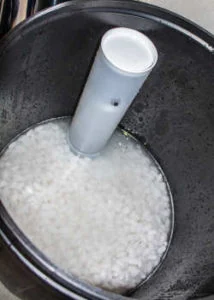
It is certainly worthwhile for the environment and your wallet! Salt is needed to regenerate a water softening/descaling system. This salt replaces the calcium in your water. More precisely, calcium and magnesium ions are exchanged for sodium ions. These calcium and magnesium ions are responsible for water hardness. Once the calcium is gone, the water is soft. A softening system therefore turns hard water into soft water. However, this process has an environmental cost. As explained in detail elsewhere, a modern water softener uses around 50 grams of regenerating salt and 2 liters of drinking water per degree of hardness. At 20° German hardness, approximately 1 kg of salt and 40 liters of water are consumed per cubic meter of soft water. Older systems or systems that are not up to current technical standards often consume more than twice as much salt and water. At first glance, this may not seem like much. For a four-person household, however, it adds up to 250 to 500 kg of salt per year and up to 20 m3 of additional drinking water consumption. Extrapolated to towns and municipalities, these figures represent very large quantities of salt and drinking water.
Why install a water softener at home?
People have different reasons for installing a water softener. Some do not want hard water and want to protect their pipes, appliances and machinery. Others want shower glass without limescale stains and clean tap aerators. Others want to make household cleaning easier: less time spent keeping the bathroom clean, without using harsh chemicals.
A Merus Ring can do all this too
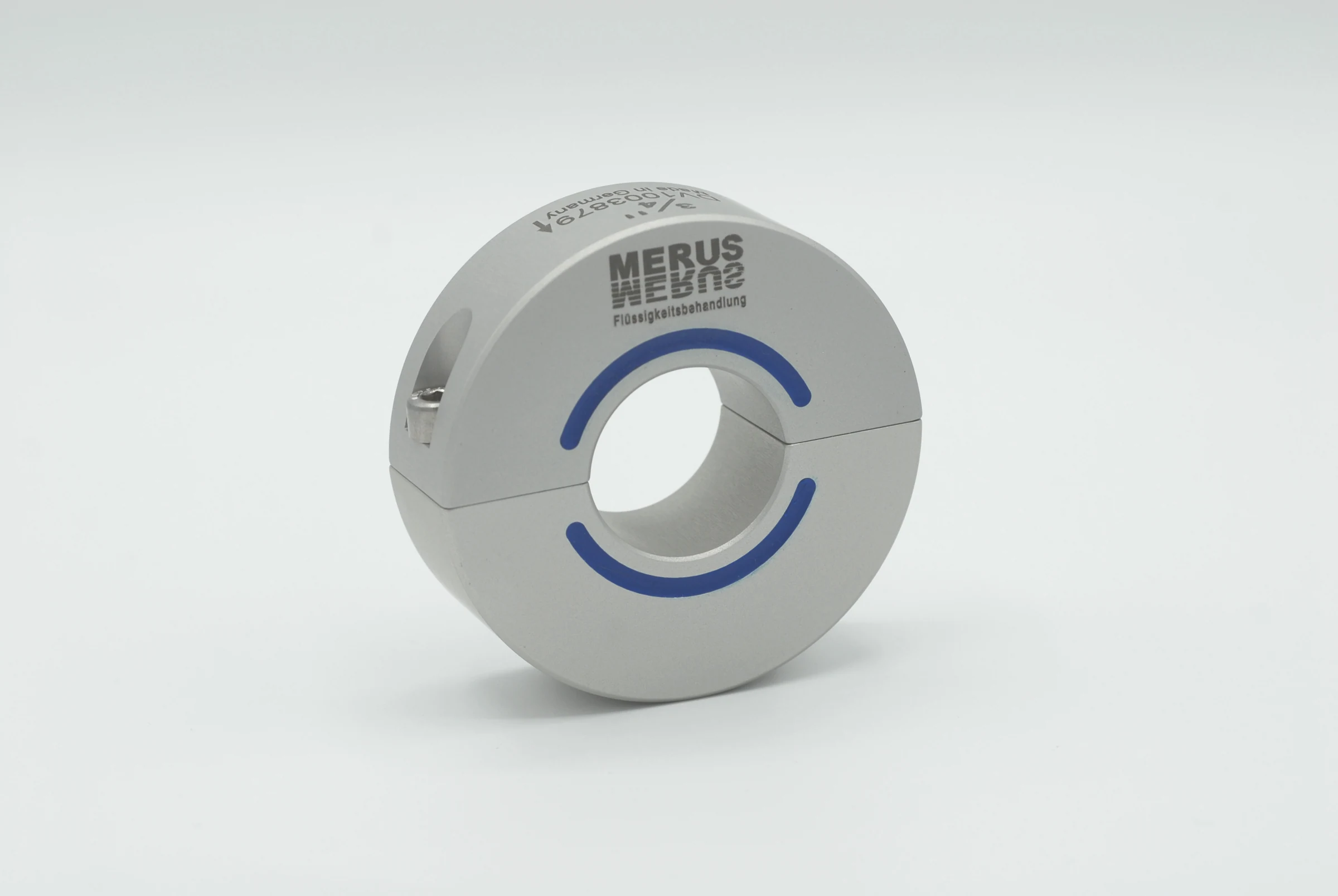
Our Merus Rings can provide virtually all the benefits that make installing a water softening system worthwhile, usually at a much lower price. One Merus Ring is sufficient for a household. Merus does not remove calcium from the water as a water softener does, and our device does not change the water's degree of hardness. Instead, the Merus Ring increases the solubility of calcium in the water. This keeps it dissolved rather than deposited on surfaces. At the same time, the water's surface tension is reduced. This is how we turn hard water into soft water.
Another advantage is that the Merus Ring works without electricity. The ring requires no maintenance, and you can carry out the simple installation yourself. The Merus Ring not only has a low purchase price; it also involves no ongoing costs for maintenance or spare parts.
An environmental advantage
The Merus Ring not only offers an attractive price, but also has a very small carbon footprint. The small Merus Rings for household use weigh an average of 220 grams. Manufacturing this Merus Ring generates only 6.5 kg of CO2. You can find the detailed calculation on our ProductCarbonFootprint page. Watching Netflix for 2 hours generates 6.4 kg of CO2; one kilogram of beef from Germany generates 13 kg. Manufacturers of descaling systems do not provide any figures for the CO2 generated in manufacturing their systems. The CO2 impact of the salt consumed or the additional water used for flushing is very difficult to determine.
In a suitable environment, the Merus Ring works for 20 years or more. If, contrary to expectations, our device loses effectiveness sooner, it does not have to be thrown away. The same ring can be recharged. If your Merus Ring is eventually no longer needed, it is a valuable recyclable material rather than waste.
The best part comes last. You do not have to buy the Merus Ring immediately. You can first try it for free or rent it for 6 months.

Source page: merus.de/entkalkungsanlage-ohne-salz