In the summer of 2022, the situation is the same in almost every European country. It is raining less and less. More groundwater has to be used to keep agriculture, industrial plants and power stations operating. As a result, groundwater is being overexploited. When the situation becomes critical, the authorities impose restrictions. Until now, we in Germany had only seen rivers drying up on television, in countries we knew from our holidays.
Today, our major rivers, such as the Rhine, Elbe, Weser and Danube, also have low water levels. Smaller rivers, such as the Panke in Berlin and the Dreisam in Freiburg, no longer carry any water in some stretches. The picture shows the Rhine near Cologne as an example. At normal times and water levels, the water reaches the tree at the right-hand edge of the picture. Today, sandbanks are visible in the Rhine, not only here in Cologne but at many points upstream and downstream. Such low river levels directly create bottlenecks in inland shipping. The cargo carried by inland vessels has shrunk to a third or even a fifth. This leads to supply shortages and significantly higher transport costs.
What can be done?
At present (August 2022), a wave of drought coverage is sweeping through the media. Every channel is discussing low water levels, drought, poor harvests and water scarcity. The focus is mainly on the status quo, presumably because there are too few solutions that can be implemented quickly. We at Merus have been discussing these issues for years. Probably partly because our business takes us to regions where the situation we are now experiencing in Germany has long been a reality.
Merus has two possible solutions at hand: one for saving feed water in open cooling systems, and one for dealing with groundwater that contains more minerals because groundwater levels have fallen.
More minerals in groundwater
When there is not enough rain, rivers carry less water and eventually dry up. Groundwater levels fall as well. These phenomena and their effects can already be observed in many parts of the world. Well-known examples include the Nile in Africa, the Ganges in India, and the Colorado River and Rio Grande in North America. All these water resources are overexploited. This means that more water is withdrawn than flows back in. There is too little rain or snow to replace the quantities withdrawn, and groundwater levels fall. Existing wells yield less water or even run dry. The response of water users along these rivers is to drill ever-deeper wells. The water extracted contains more minerals (TDS) and more iron. In many countries, this ultimately leads to soil salinization. Beyond a certain point, farming on such soils becomes difficult or impossible. Merus can help with its Merus Rings, mitigating soil salinization and the formation of iron deposits on plants and surfaces. This does not directly produce large water savings, but at least it makes it possible to use problematic water too.
Saving water in open cooling systems
In open cooling water systems, meaning systems with a cooling tower open to the atmosphere, there is only one parameter that can be influenced: the blowdown and the resulting fresh-water make-up. When water evaporates in a cooling tower, only the water itself evaporates. Any salts and minerals it contains do not evaporate. This means the remaining cooling water contains more and more minerals. This is known as concentration. It is measured as the cycles of concentration, which give the ratio of minerals in the cooling water to those in the fresh water. Here you will find a video and an explanation with detailed information about concentration.
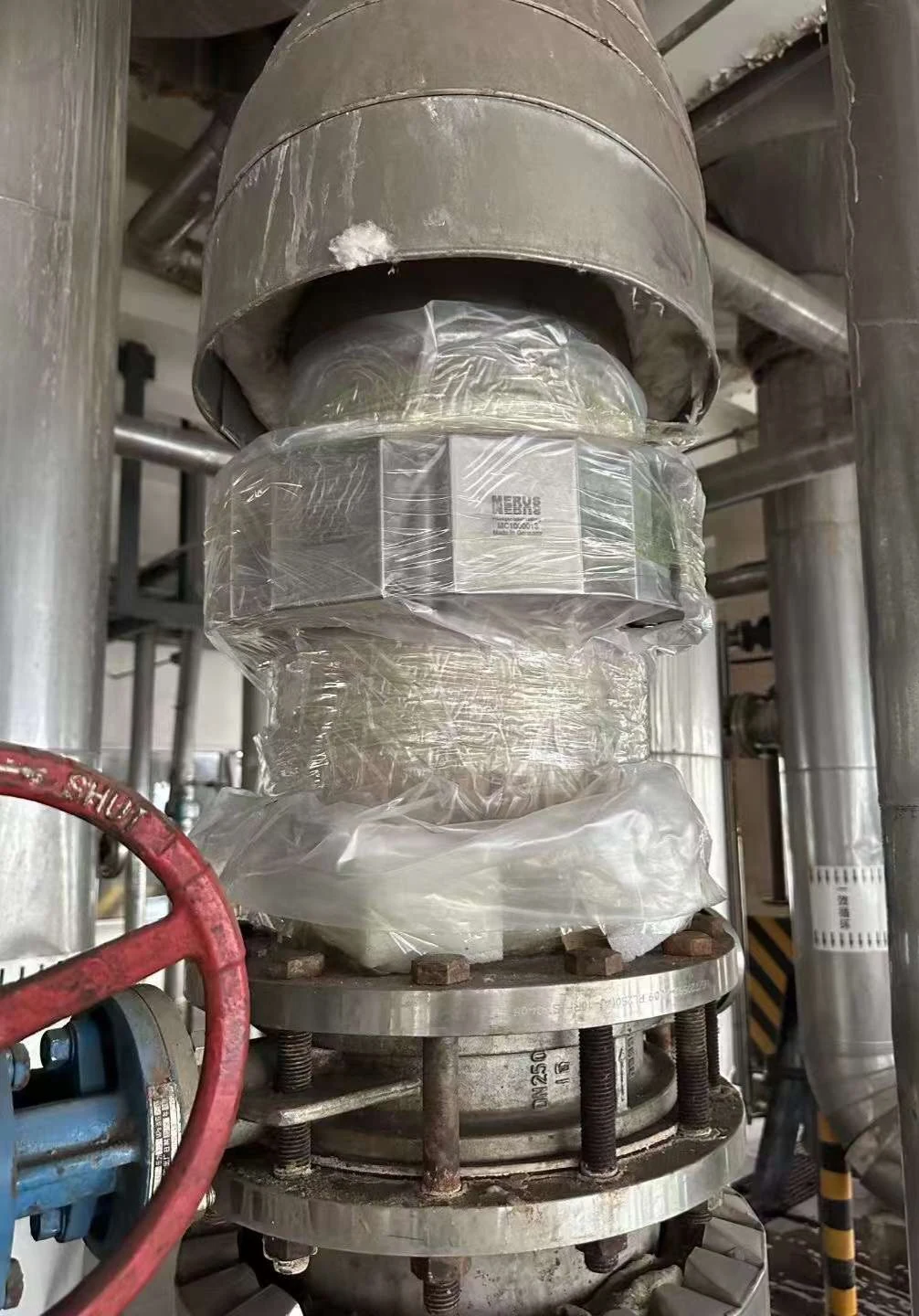
Many users operate their cooling water at very low cycles of concentration. After all, water used to be plentiful. At the same time, many operators are reluctant to accept the increased risk of limescale forming in the cooling circuit. However, Merus Rings can prevent this limescale formation.
Increasing the cycles of concentration by 50%, from 1.5 to 2.25, reduces the water used for blowdown by 40%.
You can use the interactive table to calculate the savings for your local conditions. In the blue fields, enter your current values for water consumption, the conductivity or TDS of the feed water, and the value at which you blow down. Press Enter or click Update. The savings are displayed automatically according to the percentage increase in the blowdown threshold.
Assumptions: no drift loss, constant TDS in the circuit, constant cooling performance V = volume vg = total consumption bl = blowdown fr = fresh water ve = evaporation
Vve = Vfr
Vvg = Vbl + Vfr
The salts added when replacing the evaporated water equal the salts removed by blowdown:
Vve * TDSfr = Vbl * (TDSbl -TDSfr)

Source page: merus.de/wasser-sparen