Fresh Water Generator on vessels free of deposits
Hapag Lloyd.
Hapag Lloyd is located in Hamburg in the north of Germany. It is one of the largest container shipping lines in the world and operates more than 100 ships. The Tokyo Express is a modern container vessel of almost 300 meter length and a capacity of 4890 TEU (Twenty food Equvalent Unit). This is were we did this case study.
A current topic in the maritime industry is green shipping. A lot of effort is made to upgrade vessels with new technology to minimize its negative impact on the environment. Using chemicals to clean or operate engines and machines is viewed critically. Hapag Lloyd, just as many other shipping companies, is looking for new measures to make shipping more environmentally friendly.
The problem in the fresh water generator
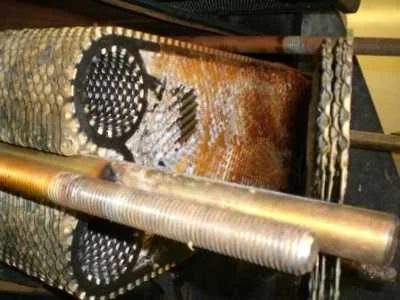
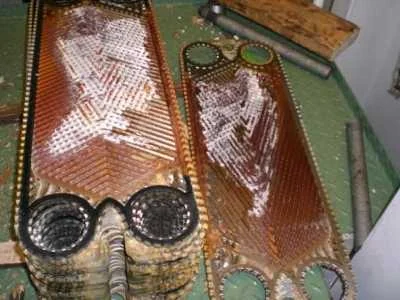
On all ships sailing on the open sea, drinking water or fresh water must be produced on the ship from the seawater. In a nutshell, in a freshwater generator, seawater is evaporated, the steam becomes fresh water, the brine goes back into the sea. On this ship an Alfa Laval freshwater generator is used. This machine has a production capacity of 25m3 freshwater a day. Despite treating the seawater with anti-scale chemicals, the production capacity declined over time. Once the volume produced reached the minimum amount of water required on the ship, the fresh water generator had to be cleaned. The production of freshwater was stopped and the generator was dismantled. Each individual plate of the heat exchanger had to be cleaned manually. One had to use chemical cleaning agents before putting it back to work. In addition, all seals had to be replaced during the cleaning process.
The cleaning process not only produces costs it also means that while the cleaning work is done no fresh water is produced on the vessel.
The solution
Monitoring the performance
The system automatically collects data on production volume and pressure in the generator. Therefore, it is quite easy to monitor the development inside. Under normal conditions, a gradual pressure drop is expected, as described above. After installing the Merus ring, we recorded an amazing increase in production volume. After the increase, the value stabilized at the nominal output until today.
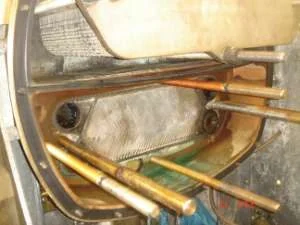
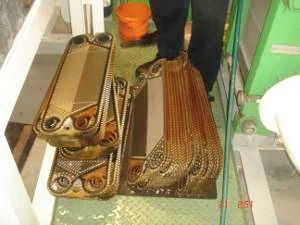
„Seeing is believing“ that’s why the fresh water generator was disassembled in the dry dock in Hongkong as planned before. The purpose was solely to see the development on the inside. The picture shows that all plates are clean, just as assumed from the monitoring data. The only dirt visible is a brown film which could be removed easily with a cloth.
We received an email of the fleet manager from Hapag Lloyd saying
There are three advantages for the customer when installing a Merus Ring. First, it is a huge time and money saver in terms of cleaning costs. Second, no chemicals are needed, which is a big step toward environmentally friendly shipping. The third advantage is that chemicals and cleaning utensils take up space on the ship, which is always a rare commodity.
After 8 month of the last cleaning the condition of the evaporator is very good. All plates are clean no residues on surface of evaporator or condenser.
The photographs document the installation described; the findings are those reported in the original MERUS case study. Source page: merusonline.com/fwg-tokyo
Related case studies

Do you have a similar process?
Tell us about your system and operating conditions – we will assess whether a MERUS Ring is suitable.
Discuss your application info@merusonline.com