42nd BImSchV – Legionella in cooling towers
Languages: English, German, French, Spanish
Since the 42nd Ordinance under Germany's Federal Immission Control Act (BImSchV) came into force on 19 August 2017, operators of evaporative cooling systems, cooling towers and wet scrubbers have been required to have their cooling water regularly tested for microbiological contamination, such as Legionella or bacteria.
This ordinance was introduced because there had been several cases in Germany of people becoming infected with Legionella. The authorities determined that the Legionella came from cooling towers at industrial sites. Legionella are aerosols and can be transmitted through water droplets. During so-called temperature inversions, evaporation plumes from cooling towers do not rise as usual. Instead, they remain close to the ground. The risk is greater when industrial sites are located in valleys, because the water from the cooling tower or wet scrubber does not rise and the aerosols containing Legionella remain in the valley. People have become infected with Legionella in this way, including those who were not in the immediate vicinity of the plant or cooling tower. The BImSchV was introduced to prevent such infections in the future.
Limits under the 42nd BImSchV
The full text of the ordinance can be found in several places online. Here is a summary from our perspective. The ordinance defines the design requirements for such installations, how they should be operated and, above all, how and what must be tested. Following irregularities, in-house checks should be carried out every 14 days. A certified testing laboratory must carry out the examination every 3 months. Testing may become less frequent only when the measured microbial counts have stabilized at a low level over a prolonged period. In an evaporative cooling system, the limits for colony-forming units are 100, 1,000 and 10,000 CFU/100 ml. If the microbial counts exceed the limit of the respective level, graduated measures must be taken. If the highest level, level 3 (>10,000 CFU), is exceeded, shock flushing with biocide must be carried out. In some cases, the entire cooling circuit is flooded. Particularly in large cooling systems, this can be very expensive.
The problem of reaching all Legionella
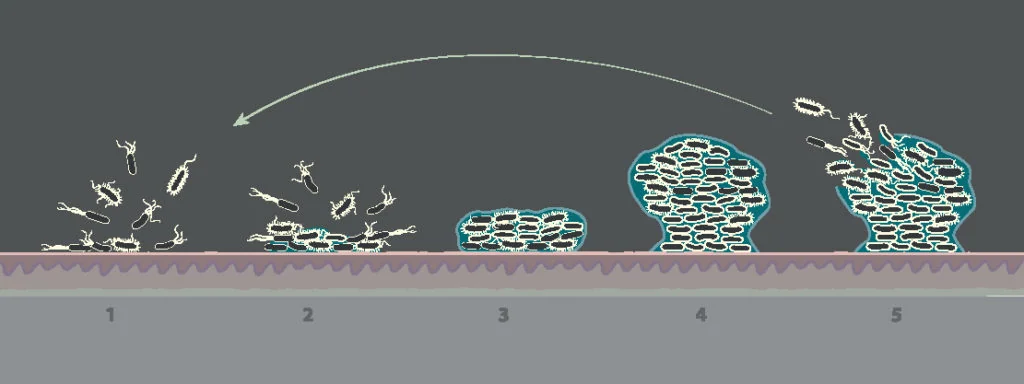
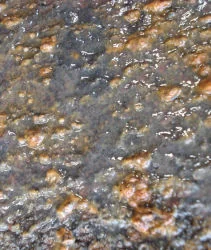
Whether in a hospital drinking water system or an industrial cooling circuit, the main challenge of any measure is always to “catch” every microorganism. Biofilms are breeding grounds for germs. If biocide treatment fails to kill all the biofilm, the germs will multiply again within a short time and the cycle starts over. As described elsewhere, biocides can affect only bacteria with which they come into contact. The same applies to heat disinfection or UV systems. If a germ is well protected in a thick layer of biofilm in a pipe with no flow, neither heat nor chemicals will reach the bacterium, let alone UV light.
Merus also works in dead legs
Dead legs are pipe sections through which water does not flow regularly. Merus technology also reaches dead legs in pipes or machinery. This is because Merus oscillations travel through the water much faster than the water itself. The oscillations also “travel” into pipe sections with no flow, minimizing the biofilm. Once the biofilm has disappeared, the bacteria no longer have a breeding ground and the colonies die out. In this way, Merus can significantly reduce microbial counts in cooling water and usually bring them below the required limits. If microbial counts remain consistently below the lowest threshold, meaning less than 100 CFU/100 ml, the frequency of testing can also be reduced.
Many customers then stop using biocides or thermal measures. This enables cooling system operators to achieve considerable savings.


Source page: merus.de/42-bimschv-kuehltuerme